

Moroccan Bread: A Local Guide to the Most Loved Breads in Morocco
Nothing beats a freshly baked bread straight out of the oven, torn open while it’s still hot, with butter slowly melting inside and a drizzle of pure honey on top — all paired with a steaming glass of Moroccan mint tea.
If that sounds like your idea of a perfect breakfast, you’ll feel right at home in Morocco. Bread isn’t just something we eat here — it’s part of our daily rhythm, from breakfast to lunch, dinner, and everything in between.
In Moroccan culture, bread is so essential that in Darija (Moroccan Arabic), the word “khobz” (خبز) — bread — is often used to mean work or livelihood. When someone says “ghadi n-qelleb 3la khobz” (“I’m going to look for bread”), they really mean I’m going to work. That’s how deeply bread is woven into everyday life.
Bread at the Heart of Moroccan Food Culture
Moroccans eat a lot of bread — and not just with food, but as a utensil. We use it to scoop up vegetables, meat, sauces, and salads, especially when sharing tagines, grilled dishes, soups, and couscous from the same plate.
This way of eating reflects our strong sharing culture, where meals are meant to be communal and generous. There’s even an unspoken etiquette around which part of the dish is yours — a small detail that says a lot about respect at the table.
From Home Dough to Community Ovens (Ferran)
Until the 1980s, most Moroccan families made bread at home and carried it to a ferran (فران) — a neighborhood communal oven. These ovens were (and still are) strategically located in almost every traditional neighborhood and could bake dozens of round loaves at once.
You can still find many ferrans today, especially in older medinas and villages. Some now produce bread directly for sale, but the tradition remains very much alive — and the smell of fresh bread coming from a ferran is something you never forget.
The Many Types of Moroccan Bread You’ll Find Everywhere
Every region in Morocco has its own techniques, flour preferences, and small twists. But there are certain breads you’ll find almost everywhere in the country.
Below are 8 of the most common Moroccan breads, the ones locals grow up with and travelers fall in love with.
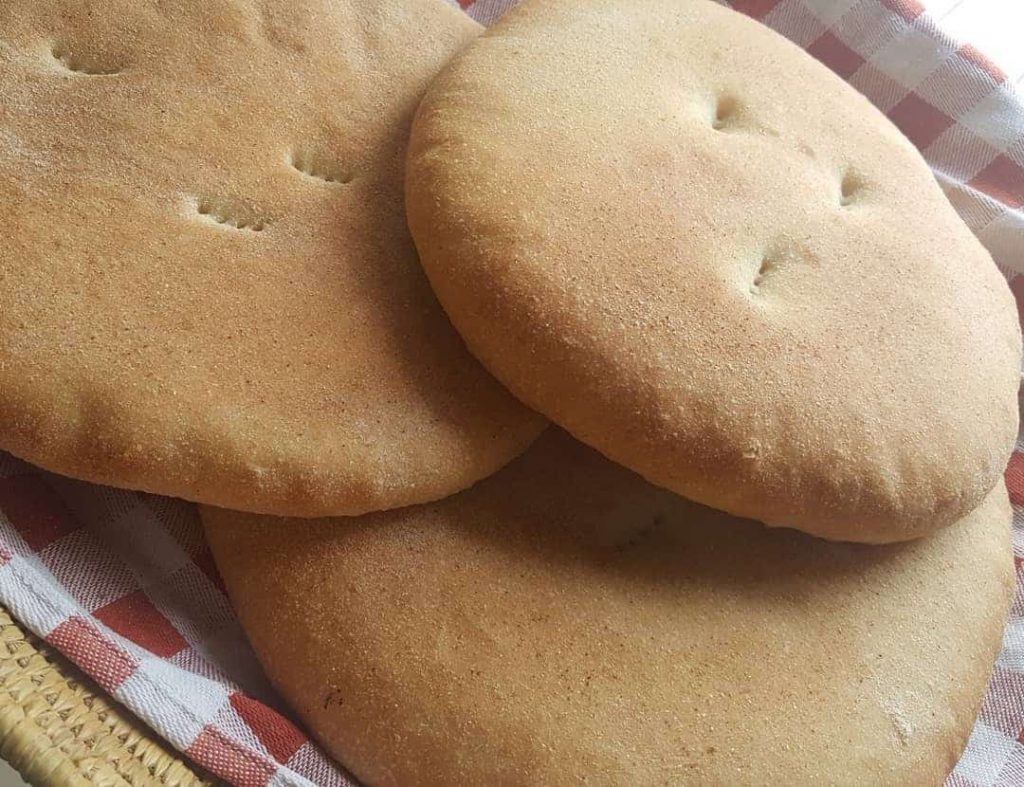
Round Bread — Khobz (خبز)
This is the most commonly eaten bread in Morocco. Baked in an oven and shaped into thick round loaves, khobz is served with almost every meal.
It’s made using different flours depending on region and preference: white flour, whole wheat, barley, semolina, or mixed grains. Each version has a slightly different texture, but all are soft inside with a lightly crisp crust.
In modern bakeries, you’ll also find flavored variations with olives, anise seeds, poppy seeds, or sunflower seeds — small upgrades that locals love.

Msemmen — Rghayef / Meloui
Msemmen is Morocco’s iconic flaky flatbread — somewhere between a pancake and a layered pastry. If you know Indian paratha, you’ll see the resemblance.
The dough is stretched, folded, and cooked on a hot pan, creating crispy edges and a soft, layered inside. It’s a breakfast and brunch favorite, often served with honey, jam, cheese, or simply butter.
You’ll also find savory versions filled with onions, herbs, or minced meat.

Rziza — “The Judge’s Turban”
Rziza is one of the most technically demanding Moroccan breads. Its name means “the judge’s turban”, referring to its distinctive coiled shape.
Made from a dough similar to msemmen, but the technique is entirely different. The dough is stretched again and again into extremely thin strands — almost like noodles — then carefully coiled before being cooked on a pan.
The result? Golden, crunchy edges with a fluffy interior. Locals sometimes call it Moroccan spaghetti — and mastering it is a real badge of honor.

Krachel — Moroccan Sweet Brioche
Krachel is pure childhood nostalgia for many Moroccans. Soft, lightly sweet, and topped with sesame seeds and sugar, it’s often baked for family gatherings and afternoons with tea.
Fresh from the oven, sliced open, and spread with butter — it doesn’t get more comforting than that.
Smell it fresh from a neighborhood oven
On our food tours we stop at a traditional ferran and local bakeries — tasting khobz, msemmen and more still warm, the way Moroccans eat it every day.

Batbout — Mkhamer
Batbout is a soft, pan-cooked bread with a chewy texture. It’s incredibly versatile: made small for sandwiches or larger for sharing.
It works just as well stuffed with savory fillings as it does with honey or jam for breakfast.
Video: https://youtu.be/SyCGHwzvA0w

Harcha — “The Rough One” (حرشة)
Harcha (حرشة) means “rough” in Darija — a nod to its grainy semolina texture.
Traditionally, it was made as one large round bread, served on a big plate with melting butter and plenty of honey, always alongside mint tea. Today, you’ll often find it in smaller individual portions.
Harcha is easy to make and endlessly customizable: cheese, olives, seeds, or mixed grains.
Video: https://www.youtube.com/watch?v=_JE9gfF-JWc
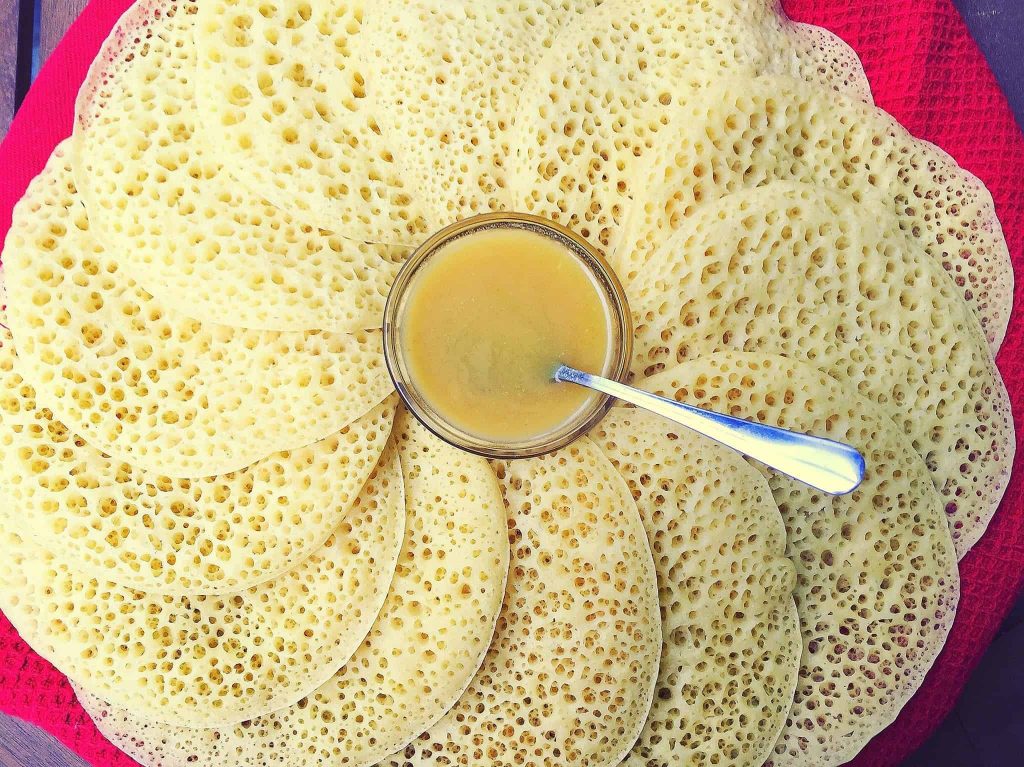
Beghrir — The 1,000-Hole Pancake
Beghrir is Morocco’s famous spongy pancake, known for its countless tiny holes that soak up butter and honey beautifully.
The perfect beghrir is judged by one thing: the more holes, the better. It’s especially important during Eid celebrations marking the end of Ramadan.

Medfouna — The Hidden Bread
Often called Berber pizza, medfouna is bread stuffed with spiced meat, onions, and herbs, then baked or cooked until sealed.
It’s hearty, flavorful, and deeply tied to Amazigh (Berber) culinary traditions — especially in the south of Morocco.
Khobz Mzewweq — The Decorated Bread (الخبز المزوّق)

This one is close to my heart. Khobz mzewweq — “decorated bread” — is a special-occasion loaf that Rabati and Fassi families bake for Eid and big family celebrations. I still remember standing by my grandmother’s oven with my cousins, all of us waiting for the very first loaf to come out so we could tear into it with butter while it was still warm.
It’s an enriched dough — eggs, a little sugar, sesame and fennel seeds — brushed golden and shaped by hand into intricate patterns, each family with its own design. And the most important ingredient, as my grandmother would say, is love (and a lot of patience).
Sadly, fewer families make it today. It really belongs to my grandmother’s generation — my own mother made it only a handful of times, and most Moroccans my age or younger have never even seen it. That’s exactly why it earns a place on this list: it’s a piece of Moroccan heritage worth keeping alive.
The Moroccan Baguette (الباغيط)
You can’t talk about bread in Morocco without the baguette. As a former French protectorate, Morocco kept a genuine love for it — walk into any café or corner bakery in the morning and you’ll find fresh baguettes stacked high. We grew up eating it split open with cheese, olive oil and mint tea, or dipped straight into a tagine. It’s proof that Moroccan bread culture keeps absorbing outside influences and quietly making them its own.
Final Thoughts
Moroccan bread isn’t just food — it’s memory, culture, and identity. Every loaf tells a story of family kitchens, neighborhood ovens, and shared meals around a single plate.
If you want to truly understand Morocco, start with the bread. Everything else follows.
Until our next culinary journey together…
Start with the bread — taste it with us
Break fresh bread on a guided food tour, or learn to make msemmen and harcha yourself in a hands-on cooking class with a local host.
5 Comments
Terry Hanson
Please help me. We went to Morocco souk and bought a flat bread from a seller. It had a sweet taste and could be roled. I was told it is only made in Marrakech do you have the name and recipe please
Mohamed Mohamed Benmokhtar
That should be Msemmen or Rghayef and the sweetener is honey or some kind of Jam … if you have a picture of it send it to me and i’ll give you more specifics 😉
Bouchra
That’s M’semen. You can find it anywhere in Morocco. The guy was pulling your leg. ?
Recipes can found on YouTube.
Cheers!
I hope you had a great experience in our beautiful country.
Genna
Hi,
Could you please tell me what the equivalent of khoubz zraa is? In English.
And also what is the flour used for that very tasty very dark Moroccan bread? I think one of my friends from Morocco said it’s Noukhala ( not sure how to spell it). What kind of flour is that?
Thank you so much .
Mohamed
Hello dear Gena, Thank you for your comment, Khoubz Zraa will whole wheat bread. for the Dark bread i presume it’s made out of Barley flour and usually it will use the Bran and rough crushed grains of marley as well to make the nice crust of the loafs as for Noukhala” (نُخالة) in English translates to “bran”. It refers to the outer layer of cereal grains, such as wheat, barle, which is often separated during milling. Bran is rich in fiber and nutrients and is commonly used in baking and bread here in Morocco