

It was in the Atlas Mountains that I understood, for the first time, that food can be a kind of language.
It was winter when I arrived in a small village high in the mountains, and the first thing I noticed was the smell: wood smoke, steam and warm bread drifting out of a family kitchen. Someone lifted the lid off the couscous pot, and the whole room seemed to lean toward it. Nobody said anything. Nobody had to. That smell meant: come, sit, you are home.
It was a language without words, and it spoke of generosity. Everything was offered before I could ask: the best place by the fire, the warmest blanket, the biggest piece of bread, the last glass of tea. Nobody wanted to know who I was or what I could give back. They fed me, and in that simple act there was kindness, warmth and a kind of love I did not have the words for. I learned more about welcome in one evening at that table than in years of eating out.
I had eaten Moroccan food all my life, or so I thought. That trip changed what I believe Moroccan cuisine really is. Now, when people ask me where it really begins, I never think of a restaurant or a fancy menu. I think of that kitchen, and of the mountains, where the Amazigh have lived for thousands of years, Amazigh cuisine is the oldest layer of Moroccan cooking. Before the Arabs, the Andalusians or the French. When you eat in the Atlas, you are tasting the oldest layer of Moroccan food.
A day that began with warm barley soup (hsoua)
In the village, the days had a rhythm, and the food kept the time.
The day started early, while it was still dark outside, with a bowl of steaming barley soup (hsoua), made from barley (belboula). It is simple, filling and good for you, the kind of breakfast that sends you out into the cold ready for anything. With it came mint tea (atay), always mint tea. Around ten came the second meal of the morning: bread still warm from the oven, olive oil poured generously, sometimes a piece of semolina bread (harcha) with a little butter and honey. Then the long middle of the day, a slow stew in a clay pot (tagine) bubbling on the fire, because a tagine cannot be hurried and nobody in that village ever tried.
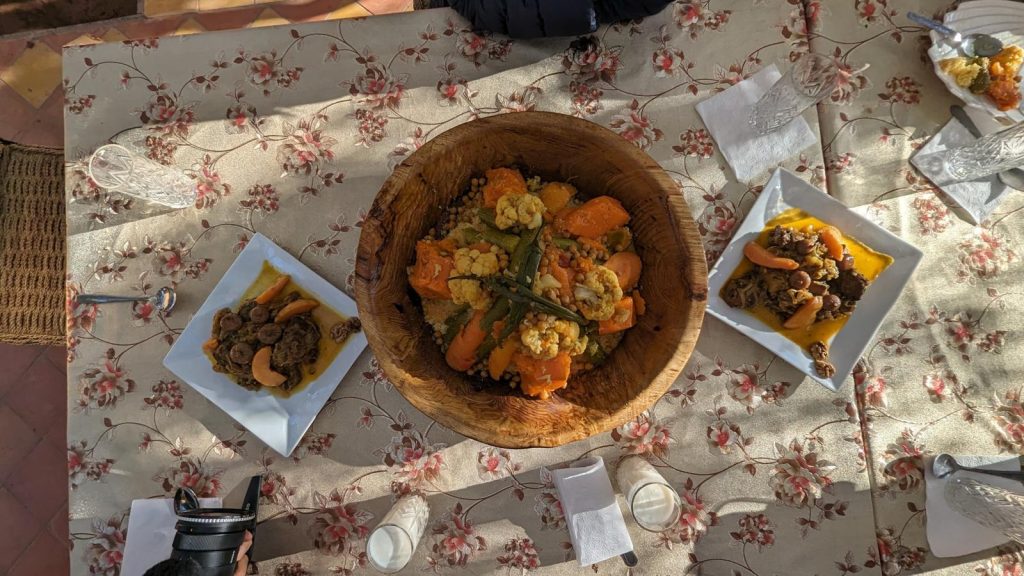
And at night, couscous (seksou). Every evening of that trip it came to the table, and I never once got tired of it. It changes with the seasons: carrots and turnips and pumpkin in the cold months, and, I was told, fresh courgettes and tender broad beans when spring comes back. The dish is the same and never the same. That is the secret of this cuisine. It does not need to be new. It needs to be honest.
Food shaped by the mountain
Life in the Atlas follows the seasons, whether you want it to or not. Families grow barley and wheat in terraced fields, look after olive and walnut trees, and keep a few goats and sheep. Winters are cold, and villages can be cut off for days, so food was built to last: dried, preserved, stored in communal granaries and cooked slowly over wood fires.
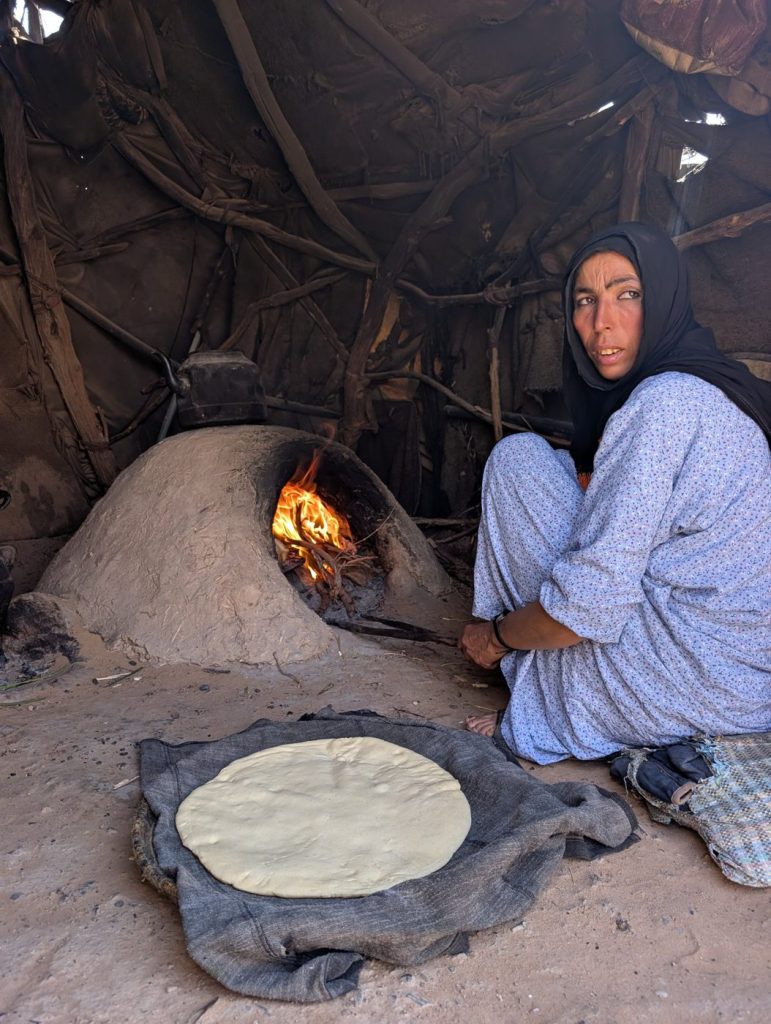
That is why Amazigh cooking feels so honest. There is very little waste, nothing is rushed, and every dish has a reason to exist. A bowl of barley soup warms a shepherd in January. A big plate of couscous brings a whole village together.
The night the mountain got cold
I want to tell you about one night in particular, because it explains this food better than any recipe.
We were in a village high in the Atlas, and the sun went down the way it does in the mountains: suddenly, and with a promise to make you pay for it. Within an hour the air had teeth. You could see your breath. The stars came out so thick and so close that I stopped talking just to look at them.
Someone lit the fire. We pulled our blankets around our shoulders and moved in close, knees almost touching the embers, faces glowing orange while our backs stayed cold. The tea came out. Of course it did. Poured from high above the glass, foam on top, sweet and strong enough to wake up your whole body.
Then the couscous arrived, one big dish in the middle, steam rising into the dark. We ate from our own side of it, with our hands or a spoon, and the old man beside me kept quietly pushing the best pieces of vegetable toward my side. He never said a word about it. That is how hospitality works here: you notice that your plate is never empty, and you never catch anyone filling it.
After the meal, nobody left the fire. This is the part I remember most. There is something about a cold night and a warm glass that opens people up. We talked about work, about families, about the cities that pull the young away and the villages that wait for them to come back. We talked about God and money and love, and about how strange it is that a person can sit for two hours with strangers and feel more understood than in a year of busy life. Nobody checked a phone. The fire needed wood, the glasses needed filling, and the night had nowhere to be.
I went to sleep that night warm, full and a little changed. I had come looking for dishes, and I left understanding that Moroccan food is not only a list of recipes. It is a way of welcoming people, shaped by the mountain and by the patience of the people who live in it. I have been chasing that feeling ever since, and it is a big part of why I do this work.
The weekly market, where the villages meet
A friend told me, if you want to understand the mountains, go to the weekly market (souk). So one morning, before the sun was fully up, I went.
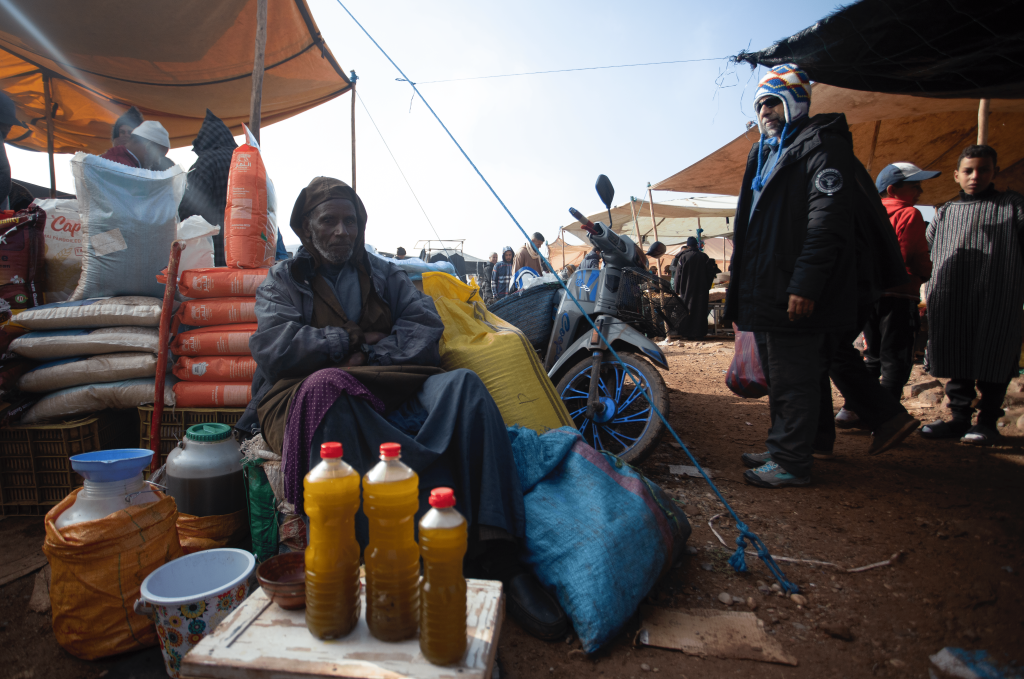
People were already arriving from every village around. Each one had brought whatever they had made or raised: milk, butter churned by hand at home, a sheep or a goat on a rope, a handwoven rug (zarbiya) folded over an arm. Nothing came from a factory. If you made it, you brought it, and somebody would want it.
It was loud and it was happy. Neighbours who only see each other once a week greeted each other with long handshakes and longer questions about family, rain and the harvest. Prices were argued with a smile. Nobody seemed in a hurry, even while the business was being done.
Then, once the selling was finished, everyone went to eat. Meat was grilled over charcoal, smoke drifted over the whole market, and the barbecue became the second half of the day. You sat with whoever was next to you, tore the bread, shared the meat. A farmer who had just sold his goat offered me a piece of his, a stranger, without a second thought. The market is where the mountain does its business, and also where it eats, laughs and catches up.
Festivals of saffron and roses
The mountains know how to celebrate too, and the festivals follow the flowers
In autumn, around Taliouine in the Anti-Atlas, the saffron crocus (Crocus sativus) comes into bloom for a few short weeks. The flowers are picked by hand at dawn, and each one holds only three thin red threads, the saffron itself. Families sit together sorting the petals, and the harvest festival fills the town with music, food and visitors. A few threads of saffron are enough to change a tagine, a pot of couscous or a glass of tea.
In spring, the Dades Valley turns pink. Around Kelaat M’Gouna, the Damask roses are picked at first light, and in May the Rose Festival celebrates the harvest. The petals are dried or distilled into rose water, used in pastries and perfumes, and sprinkled over the hands of a guest as a sign of welcome.
In every one of these gatherings I saw the same thing I had felt around that first fire: people sharing what the land gave them, and making sure nobody went without.
The dishes to know
These are the staples you will meet in the Atlas, many of them born in Amazigh kitchens:
- Couscous (seksou), the steamed semolina the Amazigh made famous, served with seasonal vegetables and, on special days, meat. It is the dish of Friday, of celebration and of welcome. UNESCO has recognised the couscous tradition as intangible cultural heritage.
- Clay-pot stew (tagine), named after the conical clay pot it is cooked in, a method that suits slow fires and tough cuts of meat.
- Barley and wheat breads and porridges, baked in family ovens or in the embers, the everyday food of the mountains.
- Barley soup (hsoua) and semolina bread (harcha), the soup made from barley (belboula) that starts a cold morning, and the little bread that goes with tea.
- Olive oil, poured generously over bread, salads and couscous.
- Almond and argan spread (amlou), toasted almonds, argan oil and honey, found especially in the Souss and often served at breakfast.
- Stuffed sand-baked bread (madfouna), the so-called Berber pizza of the south, a stuffed bread traditionally baked in the heat of the sand.
- Mint tea (atay), poured from a height, offered to every guest, and never refused lightly.
Hospitality is the main ingredient
In the Atlas, a guest is never a stranger for long. Sit down in a village home and tea appears almost before you have said hello. A meal follows, often shared from one large dish at the centre. Everyone eats from their own section, and the host makes sure your portion is never empty.
When we say Amazigh food is about people as much as flavour, this is what we mean. The recipes matter. The way you are welcomed matters more.
A living culture
The Amazigh language (Tamazight) became an official language of Morocco in the 2011 constitution, and the Amazigh New Year (Yennayer) is now a public holiday. Many families mark it with a large shared meal. It shows how deeply this heritage belongs to the country’s identity, and that the food and the culture cannot be separated.
Tasting the Atlas with us
This is where our trips shine. On the Grand Moroccan Food Tour you will drive through the Atlas Mountains and palm valleys, have lunch in Rissani with madfouna being made in front of you, and hike between the fields of the Ait Arbi Amazigh village in the Dades Valley. You will also spend a night in a Sahara desert camp, where the food and the music follow the same traditions, and where the fire, the tea and the long conversations are waiting for you too.
If you want to go deeper, a custom trip can include village stays, home-cooked meals and cooking sessions with Amazigh families in the Atlas.
Come and taste where it began
Every great cuisine has a beginning. In Morocco, that beginning is in the mountains, around a fire, with a clay pot and a welcome that does not need translating. Come and sit with us. We will keep the tea hot.
Start with our multi-day trips.
Leave a Reply