

Dear friends,
I’m writing this with sand still somewhere in my bag and a smile I can’t seem to put away.
This autumn we took a group on one of the biggest journeys we’ve ever organised: a week through the mountains, valleys and dunes of southern Morocco. I wanted to tell you about it the way I would if you were sitting across from me with a glass of mint tea, because the photos only tell half of it.
So pour yourself something warm. Here we go.
There were twelve of us, three white Land Cruisers, and a week of road ahead. Most of the group had never met before the first morning. Some arrived a little shy, a little unsure what they’d signed up for, holding their bags close and their questions closer. I’ve seen that look at the start of every trip, and it is my favourite thing to watch disappear.
It started in green
People imagine Morocco as all sand and stone, and I love proving them wrong in the first days.
We drove to the waterfalls: red cliffs split open by water, loud and green and alive. By the time we left, strangers had turned into a group that was already finishing each other’s jokes.
You hear them before you see them. First a low rumble somewhere beyond the rocks, then a cool dampness on your face, and then the whole thing opens up: water pouring down red stone into green so bright it looked unreal after the dry road. People stopped mid-sentence just to stare. Then the phones came out, then the laughter, and somewhere in between the first real conversations of the trip began.
My favourite part of this work is that you never have to introduce people. You just put them somewhere beautiful and let them find each other.
The mountain road with a sense of humour
Up in the Djebel Sarhro, the road climbs and twists until you start to wonder who builds roads like this. And then you find the answer: people with a sense of humour.
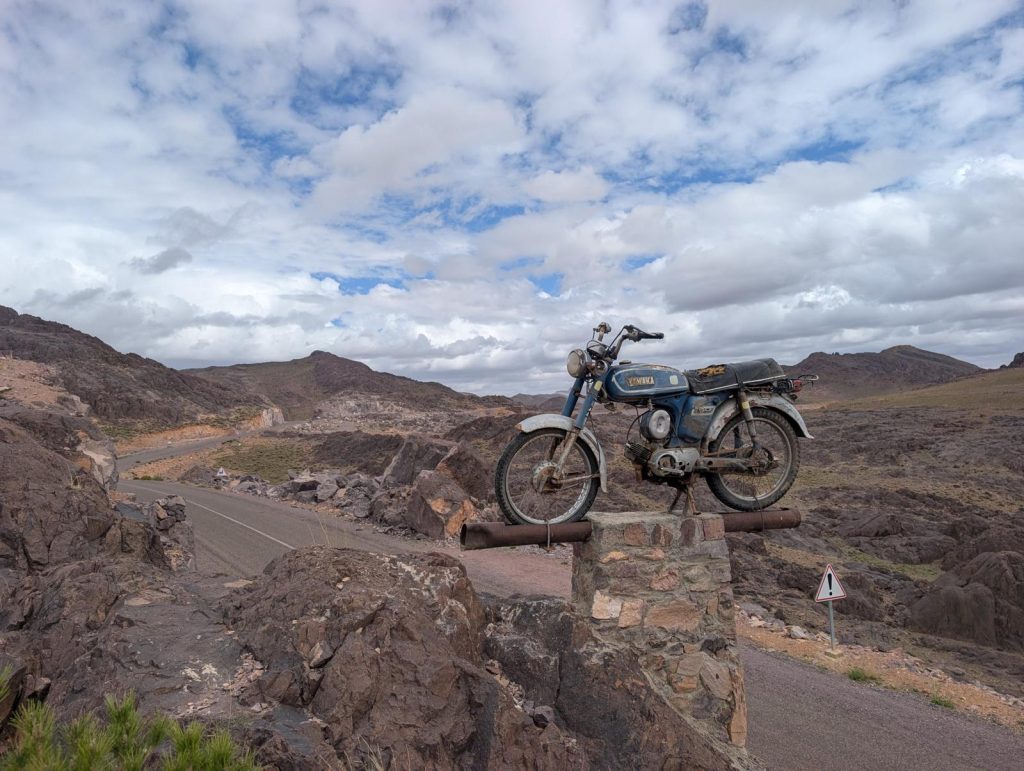
At the top, a cannon made from old pipes and a bicycle wheel guards the viewpoint. A homemade windmill spins on a pole. A little further along, an old blue Yamaha moped sits proudly on a stone pillar, as if it just parked there and went to get tea.
I could have spent the whole afternoon up there just looking at the details. Somebody had built all of this by hand, with whatever they had, for no reason except to make people smile as they came round the bend. In a country this old, I find that kind of joy very moving.
We squeezed together for the group selfie, 2,300 metres above everything, wind in our scarves, laughing so hard the photo came out crooked. I wouldn’t change a pixel.
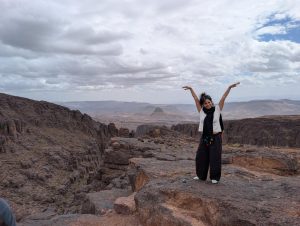
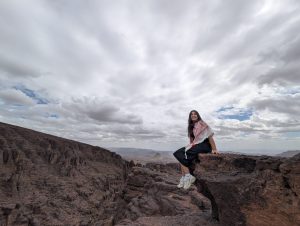
Up there the air is thin and clean, and the valley falls away in folds of brown and rust. It is the kind of quiet where you can hear your own laughter travel across the mountains and come back to you. Some of us stood very still at the edge, some of us couldn’t stop moving, and all of us were a little bit speechless.
On the way down, a flock of sheep took over the road and we had no choice but to wait, wave and enjoy it.
The flock moved at its own pace, and for a while the whole schedule belonged to the sheep. Windows came down, hands waved, and nobody checked a watch. It was the first time on the trip I felt everyone truly let go of the world they’d left behind.
A palm valley, and everyone in scarves
Our next stop was a viewpoint above a river of palm trees, with a town of red-earth houses spread out below. A row of hand-embroidered scarves hung along the railing like a rainbow somebody forgot to take down.
Within five minutes, half the group had been wrapped, tied and turbaned, some with only their eyes showing, while the other half laughed too hard to take the photo. It became our unofficial group portrait, and honestly, it’s the one I’ll keep.
There is something about wrapping a scarf around a friend’s head that ends all formality. The scarves were tied with great seriousness and terrible technique, and the results were gloriously uneven. The colours, red, gold, deep blue, glowed against the pale valley behind us, and for a moment we looked like a small travelling troupe that had arrived from somewhere much older than this century.
The dune at first light
Every trip has a moment. This one came at dawn.
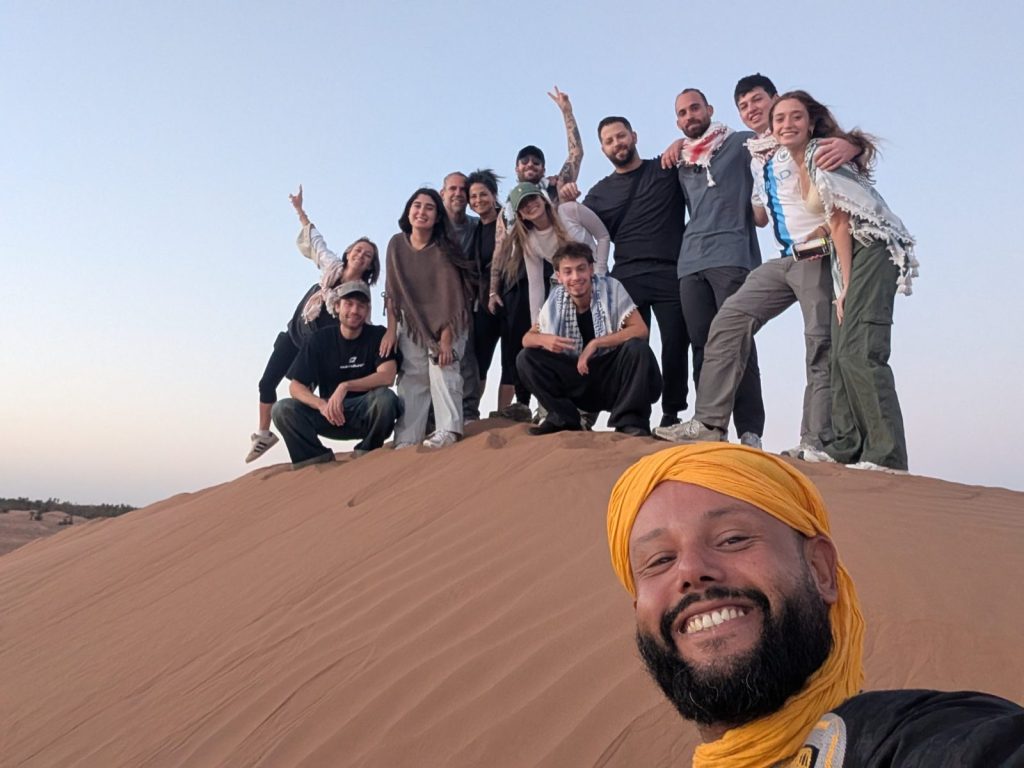
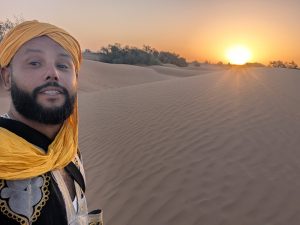
We climbed a dune together, slowly, in the kind of soft silence only sand can give you. At the top the sky was shifting from blue to lilac to gold, and nobody said a word. Then, with no signal from anyone, the whole group threw their arms up at once.
Sand is honest about effort. For every step you take, it takes half a step back, so you quickly stop trying to be fast. The group stretched into a slow line, each person following the footprints of the one ahead, our shadows long and blue on the slope. The only sounds were breathing and the soft hiss of sand sliding away behind us.
I keep that silhouette on my phone: a dozen people, arms high, scarves flying against the colour of the sky. Nobody planned it. Nobody had to.
I think about why that moment worked. It wasn’t the view, though the view was extraordinary. It was that twelve people who had been strangers a few days earlier were standing at the top of the same dune, feeling exactly the same thing, at exactly the same second. You can’t schedule that. You can only get everyone to the right place and then step back.
That’s the Morocco I want you to meet.
Quad bikes and sand in everything
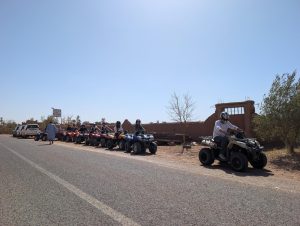
By mid-morning we had swapped the Land Cruisers for quad bikes, a long line of helmets and machines in red, orange, yellow and blue, rolling past mud-brick walls and palms. Later we stopped wherever the sand looked too good to ignore, and somebody always ended up on somebody’s shoulders.
The engines were loud, the dust was everywhere, and I don’t think any of us stopped grinning for a long time. We rode in a long, bright line past old walls and palms, the kind of landscape you usually only see from a window, except this time we were right inside it, with wind in our faces and sand in our teeth.
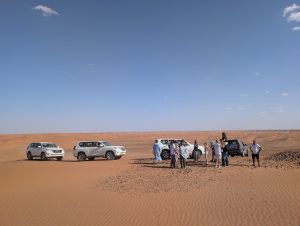
Three white Land Cruisers and a very big sky
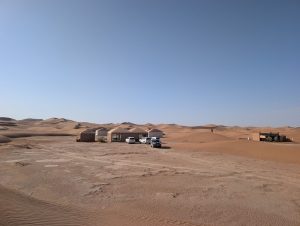
On our way out of the dunes, we left camp behind, tents the colour of the sand, dunes in every direction, and the sun already warm.
hen the landscape opened up. First came a vast cracked lakebed, dry and flat to the horizon. Then a stony plain with flat-topped red mesas on the skyline, and there we simply stopped. Doors open, people climbing onto bonnets, someone standing through the roof waving at nobody. There was no café, no signal, no schedule. Just a sky that blue, over a plain that red.
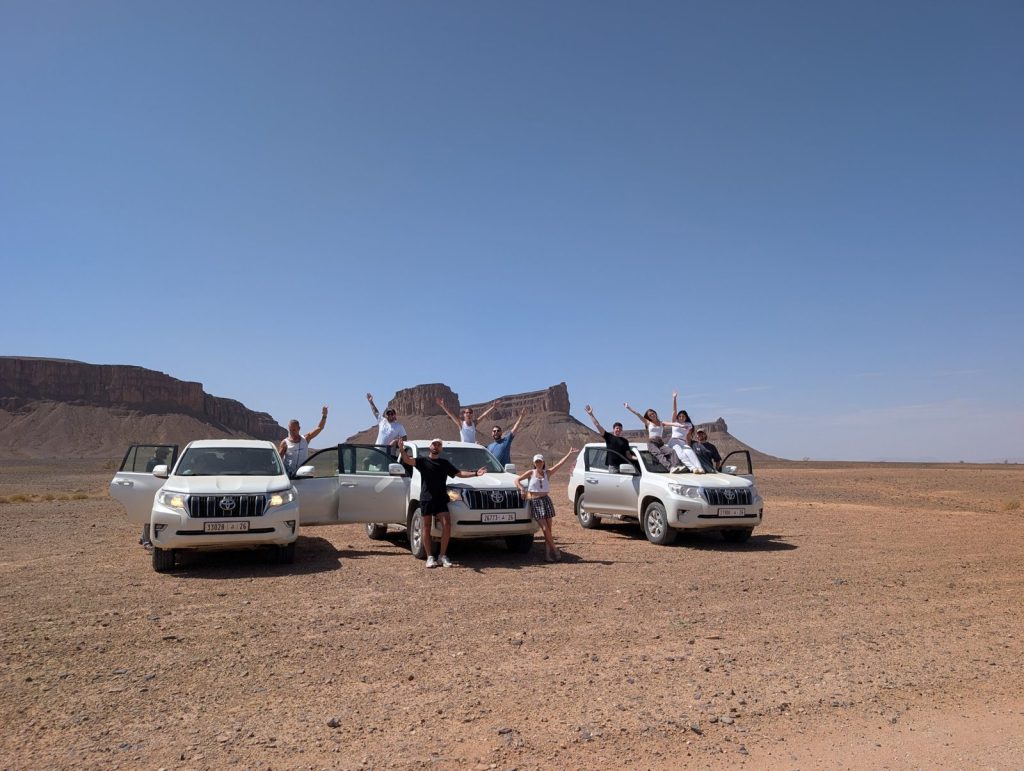
I remember thinking: this is what we mean when we say “off the beaten path.”
Out there, silence has a texture. There was no engine, no voice, no notification, only a wide, warm emptiness that made us all speak more softly without being told to. A few of us wandered off alone for a minute, just to stand in it. Then someone laughed, someone else climbed onto a bonnet, and the spell turned into joy again.
Back in green, and then the table
Near the end of the trip we found ourselves in green again: a leafy garden where cobalt-blue walls glowed behind the palms and everyone slowed down without being asked.
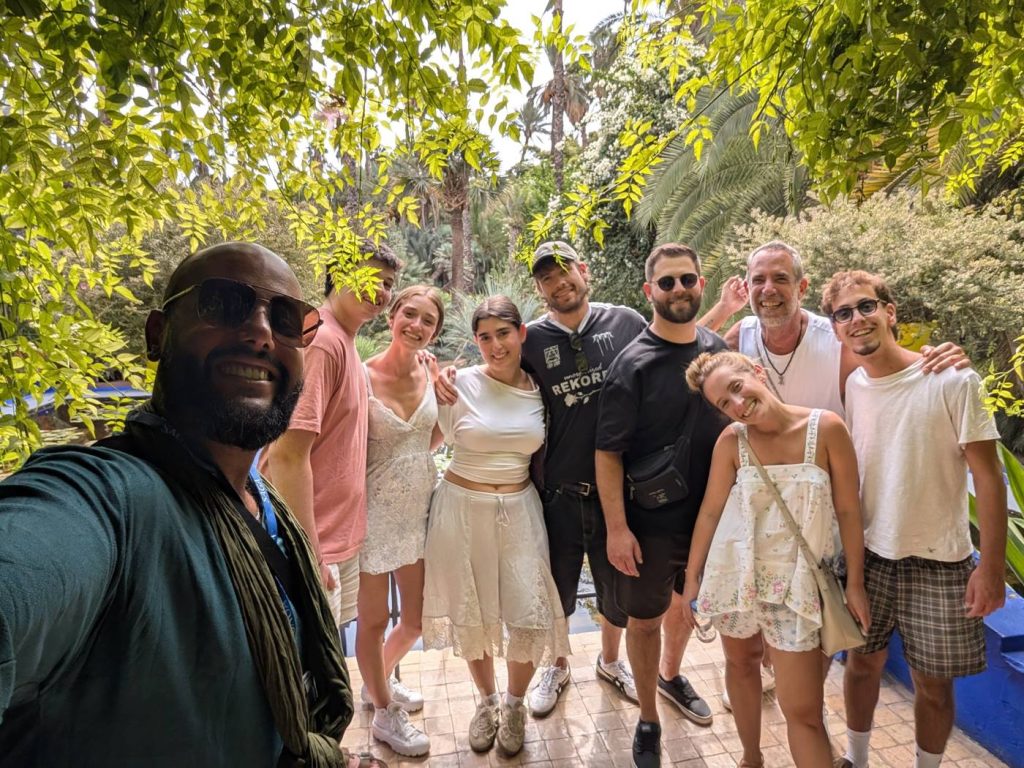
I’m a food guy at heart, so I’ll end where I always end: at the table.
On our last evening we gathered in a lantern-lit room, curtains drawn, a mirror glowing on the wall. The table slowly disappeared under little plates stacked on iron stands: chicken tagine with preserved lemon, vegetable couscous and pastilla, salads, vegetables, dips, things people asked me to name and then asked me to repeat. Plates were passed without anyone asking. For a while no one took a photo, because everyone was busy eating.
The room was warm and soft with lantern light, and after days of wide skies it felt like being gathered into a hug. Someone started retelling the story of the waterfalls as if it had happened years ago, someone else corrected the details, and the whole table laughed. We had known each other for barely a week, and already we had old stories.
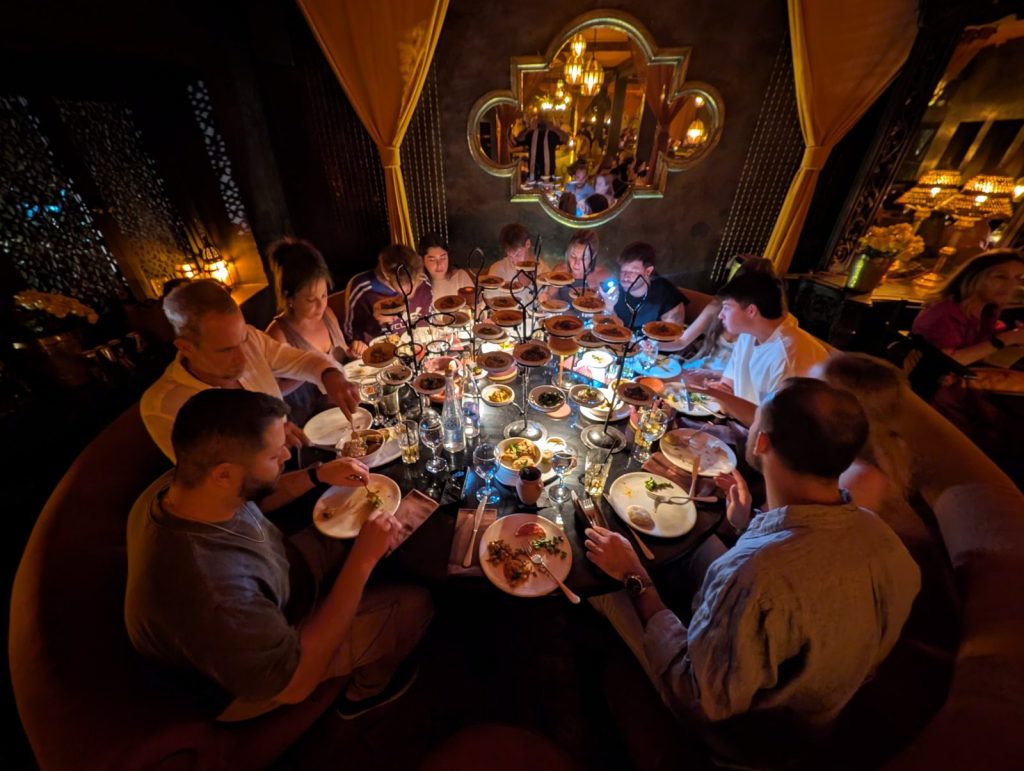
That’s when I knew the trip had worked. Not at the summit, not on the dune, but here, when twelve people who had met days before were sharing food as if they had done it all their lives.
Moroccan food does that. It turns a group into a table, and a table into a family.
If you have ever wondered whether a trip like this is for you, whether you’d fit in, whether you’d be the only one travelling alone, whether you’d be ready for it, I can tell you what I tell everyone who asks. You don’t have to be ready. You only have to arrive. The road, the sky, and the table will do the rest.
Want to see it for yourself? Our upcoming journeys are on moroccanfoodtour.com.
Leave a Reply