

Moroccan style barbecue on a rooftop
There’s a smell that means summer has really started here — not the first hot day, not the end of school. It’s the smell of charcoal drifting over the rooftops right around Eid al Adha, when every family in the neighborhood seems to be grilling at the same time, and the whole city smells like smoke and cumin until midnight.
That’s when I know. Summer doesn’t happen in the kitchen anymore. It moves outside — onto rooftops, into courtyards, wherever there’s room for a grill, a few chairs, and people who aren’t in a rush to go anywhere.
The Fire Does the Talking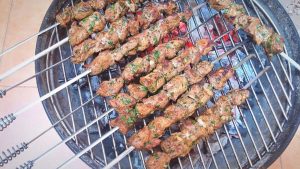
Chouaya — our word for this kind of barbecue — doesn’t ask for much. long marinades, family recipes cards, no stress. Just good meat, a pinch of spices, and someone who knows how to read a fire.
Lamb, beef, kefta — they go on with barely anything: salt, cumin, sometimes a little paprika. After that, it’s all instinct. There’s always one person standing over the coals — in our family it’s my uncle, every single time — turning the skewers, adjusting the heat without really thinking about it, because he’s done this a thousand times before.
Meanwhile, everyone else is somewhere close by, but not really watching the grill. The chairs get pulled into a circle — lgelsa, we call it — and that’s really where the evening happens. Someone’s telling a story that’s been told before. Somebody’s kid runs past with the garden hose, soaking a cousin who wasn’t paying attention, and for a second the whole rooftop is laughing.
That’s moroccan style barbecue. The meat is almost secondary.
You’ll find this same scene everywhere in the country come summer. On rooftops in Marrakech, with the call to prayer drifting over the medina. In courtyards in Fes, windows open, laughter spilling out onto the street. In small neighborhoods where you don’t even need to see the smoke — the smell alone tells you exactly who’s cooking and who’s about to be invited over.
Wherever it happens, it feels the same. Unhurried. Warm. Shared.
The Souk Has Its Own Version
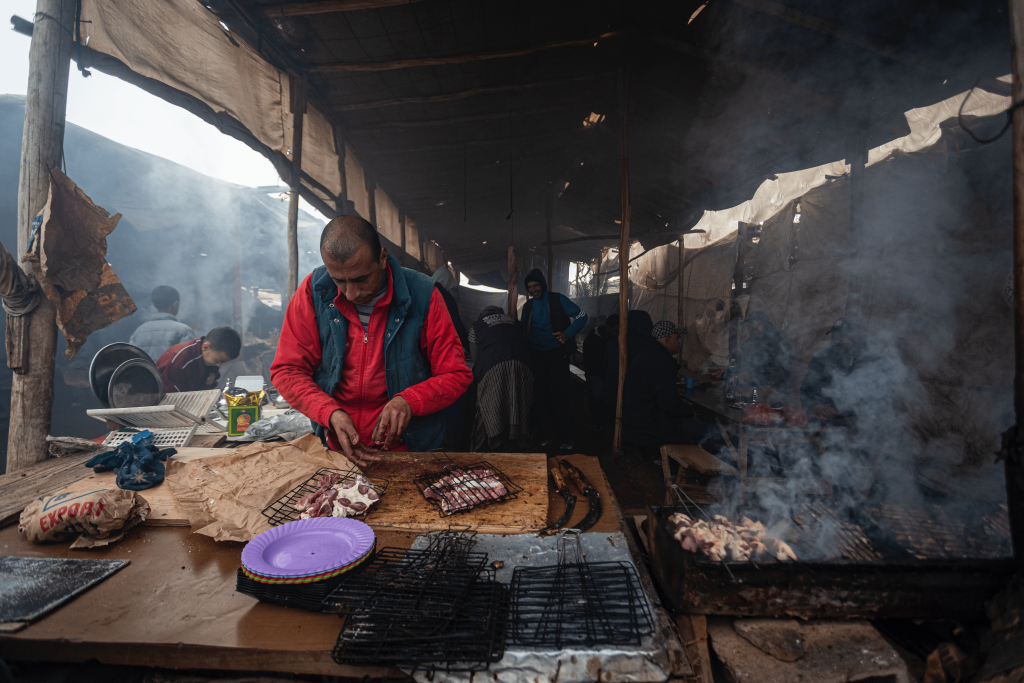
Home rooftops aren’t the only place chouaya happens. Come summer, the souk turns into its own kind of grill — and honestly, it’s a whole different experience.
Walk through any medina in the evening and you’ll feel it before you see it: smoke curling up between the stalls, mixed with cumin, grilled onions, and something sweet baking somewhere close by. Vendors stand behind small grills built right into their stalls, fanning the coals by hand, calling out to whoever slows down even slightly.
Meat is only half the story here. Just as often, it’s whole fish — sardines, sea bream, sometimes small mackerel — split open and rubbed generously with chermoula: a thick, green marinade of parsley, coriander, garlic, cumin, and a good amount of olive oil. They go straight onto the wire grill over the coals, skin blistering and charring at the edges while the flesh underneath stays soft and stays green from the herbs. You can tell a good fish grill from the char lines alone — dark and cracked in places, glistening everywhere else where the marinade hasn’t quite burned off.
Right next to it, kefta and liver skewers do their own thing on a separate grill, turned constantly, dripping fat into the coals and sending up little flares of smoke. Sometimes there’s a small clay tagine sitting just off to the side, something slow-cooking while the barbecue handles the fast stuff.
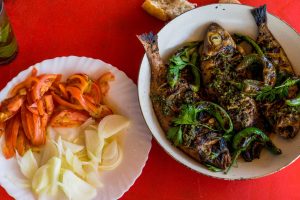
You don’t really order in the usual sense. You point at what looks good — the fish, a few skewers, maybe both — and a few minutes later a small plate lands in front of you: fresh bread, the grilled fish still a little smoky, a wedge of lemon, olives on the side. Wooden stools, low tables, shoulder to shoulder with people you’ve never met and probably will never see again, but for ten minutes you’re all doing the exact same thing — pulling the fish apart with your fingers, wiping bread through what’s left of the chermoula, not saying much because your mouth’s too busy.
The souk doesn’t slow down for anyone, but somehow, sitting there with fish in one hand and bread in the other, everything does slow down. The noise of the market fades into background — the vendors’ calls, the hum of a nearby café, someone bargaining two stalls over — and for a moment it’s just you, the smoke, and dinner.
It’s messier than a rooftop, louder, faster-paced — but it’s moroccan style barbecue all the same. Just wearing a different outfit, and this time, smelling a little more like the sea. 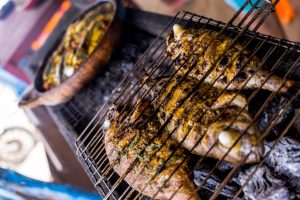
After the Grill: Where It All Comes Together
Once the meat comes off the fire, the table fills up — not all at once, not formally, just piece by piece, the way it always does.
Small plates start showing up first. Tomatoes with onion and a little olive oil. Smoky zaalouk, made slow from grilled eggplant. Peppers charred black over the same coals, then peeled by hand while they’re still too hot to touch. Fresh bread gets passed around, still warm, and nobody bothers with plates — why would you, when the bread does the job better.
People lean in. Hands reach across each other. Three conversations happen at once and somehow everyone follows all of them. Nobody’s checking the time.
This is really where the meal begins.
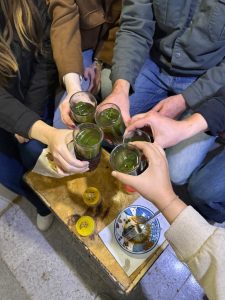
And then comes the part that slows everything down even further — the tea. Mint, sugar, and that long pour from high above the glass, more performance than necessity, but nobody would have it any other way. Glasses get passed around, refilled without asking, held loosely between sentences.
By then, the sky’s usually turned orange, the coals have gone quiet, and somewhere behind you the kids are still running around, still a little wet, still laughing about something only they find funny.
More Than a Meal
What makes a Moroccan barbecue what it is isn’t really the food — it’s everything around it. The rooftop. The lgelsa. The pace nobody tries to hurry. The fact that this is one of the few times in the week when nobody’s in a rush to be somewhere else.
There’s no strict order to any of it. No perfect timing to chase. Just fire, food, and people who showed up for each other, watching the day turn into night together.
It’s the kind of evening that stays with you — not because of what was on the grill, but because of how it felt to be sitting there.
Try It Yourself
If you’re in Morocco this summer, follow the smoke. Look up — the rooftops are usually telling you exactly where the evening is happening.
And if someone invites you up, go. Because the best Moroccan barbecue was never really about the menu. It’s shared, passed around the table, and remembered long after the coals have gone cold.
Moroccan Food Tour — bringing you closer to the flavors, rituals, and rooftops of Morocco.
Leave a Reply